
Quick Links
- What “ERP” means for a small service business
- Where MyWorkbelt covers ERP ground
- A typical scenario MyWorkbelt clients uncover
- What MyWorkbelt isn’t
- Q&A: ERP alternative for service businesses
- The next step
A traditional ERP implementation for a service business can run six figures and take six to twelve months before it produces a single usable report. A 12-tech HVAC company, or an 8-truck plumbing outfit, doesn’t have that kind of runway. They need the visibility an ERP promises without the price tag or the year-long wait.
That’s the gap MyWorkbelt was built to close.
What “ERP” means for a small service business
ERP stands for enterprise resource planning, but the term gets thrown around loosely. Stripped of the jargon, an ERP is one system that replaces the five or six disconnected tools a business normally runs on: a CRM for customers, a scheduling tool, an inventory system, a vendor and purchasing process, invoicing, and some layer of financial reporting that ties it all together.
Most small businesses never get that in one place. They run QuickBooks for the books, a scheduling app for the calendar, a spreadsheet for materials, and a filing cabinet for everything else. Nothing talks to anything else, and nobody has one screen that shows the whole business.
Full ERP platforms solve that problem for companies that can afford the implementation cost and the consultants required to configure them. A 5- to 25-employee service business generally can’t and doesn’t need most of what those platforms are built for.
Where MyWorkbelt covers ERP ground
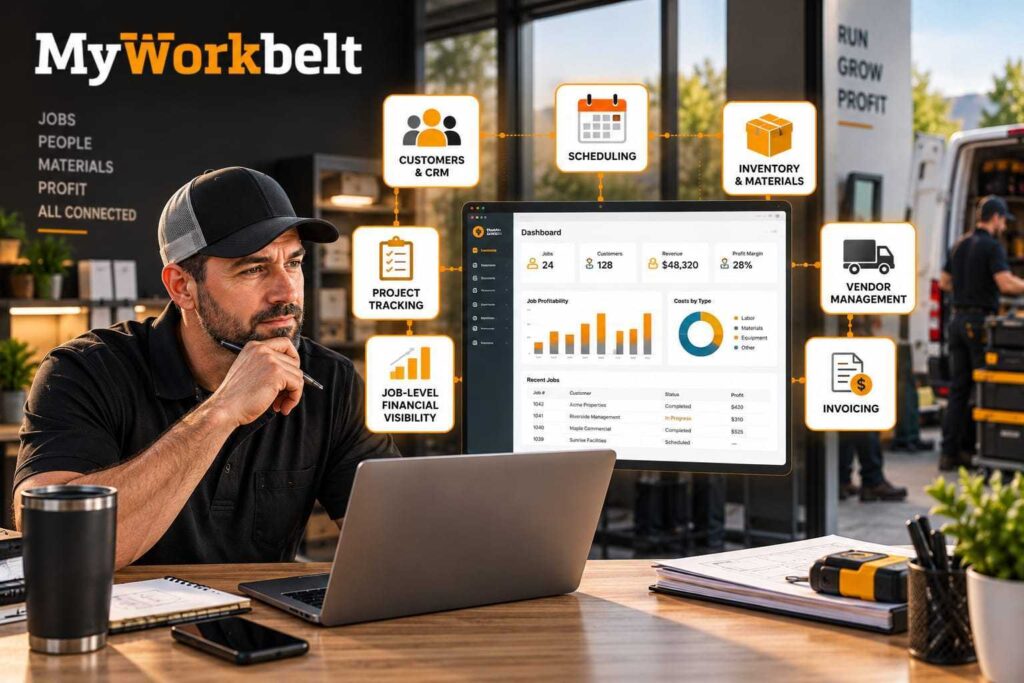
MyWorkbelt is one system that covers the same lifecycle an ERP is built to manage, sized for a small service business instead of an enterprise one.
Customer and job data in one place. Client history, service records, and property details live in one database instead of scattered across a CRM, a scheduling app, and someone’s memory.
Job-level financial visibility. This is the part most FSM software skips and most ERPs bury under general ledger complexity. Budget vs Actual tracks what a job was estimated to cost against what it actually costs- materials, labor, and time on job- and surfaces the gap by job type.
Inventory and vendor management. What parts you have, what you’re reordering, and which suppliers you’re buying from, without a separate purchasing module.
Project tracking for multi-day work. Commercial installs and larger jobs get their own timeline and budget instead of getting managed like a one-day service call.
Invoicing tied to QuickBooks. Billing and payments sync to the books you already use, validated by a QuickBooks ProAdvisor, instead of requiring a new general ledger system.
Where a full ERP asks a company to hire a project manager and a consulting firm to configure it, a MyWorkbelt Client Success Manager configures the platform around your specific operation before you go live and stays on as your monthly advisor after that.
A typical scenario MyWorkbelt clients uncover
A 12-tech HVAC operation had residential replacements such as bread and butter. On paper, the margin looked fine.
The job-level data said otherwise. Materials on those replacement jobs were running $191 overestimate, on average, across 94 jobs over six months. That’s $17,954 in cost the business was absorbing without knowing it. The kind of number for a general ledger shows you in aggregate, months after the fact, and a job-costing system built into daily operations shows you while it’s still happening.
That’s the ERP-level visibility a small service business needs not a company-wide financial suite, but the specific number that tells you where the money is going, by job.
G2’s ERP systems category confirms the pattern: buyers describe ERP value as unifying accounting, inventory, purchasing, and reporting in one connected system so nothing lives in disconnected spreadsheets. That’s the right definition. It’s also built around companies with dedicated IT and finance teams to run the implementation, which most 5 to 25-employee service businesses don’t have.
What MyWorkbelt isn’t
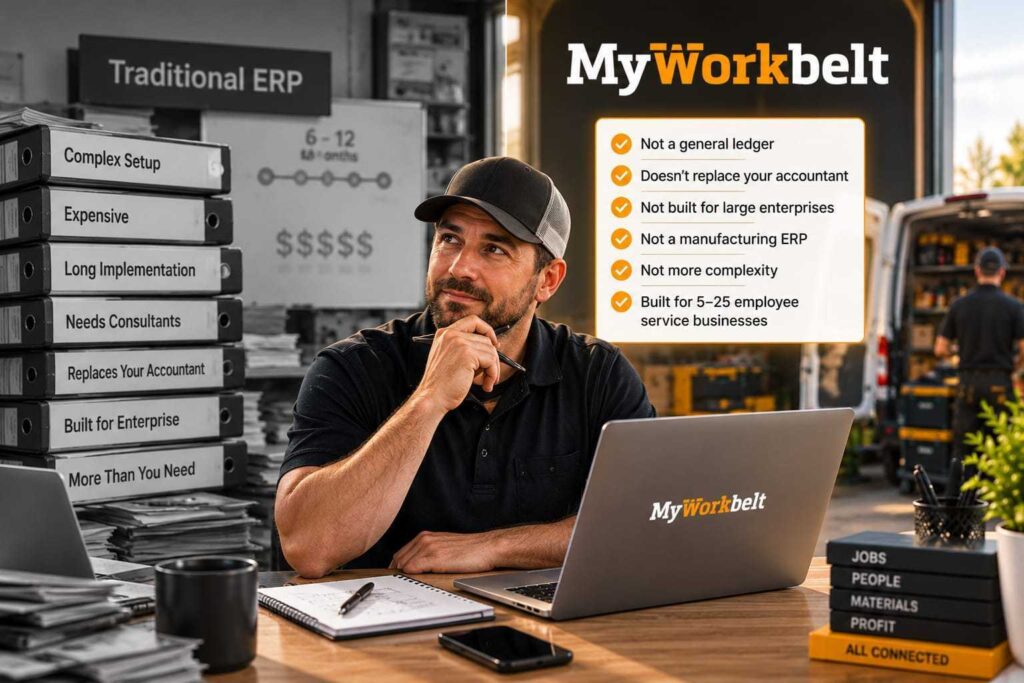
An honest answer matters more than a long feature list. MyWorkbelt is not a general ledger and doesn’t replace your accountant or your QuickBooks file. It syncs to QuickBooks; it doesn’t compete with it. It’s not built for multi-division enterprises running dozens of cost centers or manufacturing operations with complex supply chains. If that’s your business, a full ERP is the right tool.
For a 5 to 25-employee service business that needs one system to run jobs and one clear answer on whether those jobs are profitable, without a year-long implementation, MyWorkbelt is built for exactly that gap.
Q&A: ERP alternative for service businesses
Is MyWorkbelt an ERP?
It covers the core ground for a small service business’s needs from an ERP: customer data, scheduling, inventory, vendor management, invoicing, and job-level financial tracking, in one system sized for a 5 to 25-employee operation.
Why not just implement a full ERP?
Full ERP platforms are built for larger, more complex organizations. The implementation cost, timeline, and ongoing configuration overhead are usually more than a small service business needs or can absorb.
What does MyWorkbelt do that a scheduling tool like Jobber doesn’t?
Job-level cost tracking. Scheduling tools show you that a job is done. Budget vs Actual shows you whether it was worth doing.
The next step
You don’t need a six-figure ERP rollout to know whether your jobs are actually profitable. You need one system that shows you the numbers and a person who walks you through what to do about it every month.
See how Budget vs Actual works for your trade with a demo built around your job types. Setup is a one-time $500, done for you in about a week, backed by a 60-day money-back guarantee.
More from My Workbelt: MyWorkbelt vs Jobber · What the Monthly Growth Review Actually Finds · My Workbelt Pricing
Further reading: Capterra: ERP Selection Guide, Based on Nearly 1,000 Reviews · G2: ERP Systems Category Overview