Quick Links
- The Bid
- Week One: The Labor Assumption Nobody Checked
- Week Three: The Change Order That Wasn’t Priced Right
- Week Five: The Material Price Shift
- Week Seven: The Callback
- Closeout: What the Numbers Actually Say
- Where Budget vs Actual Fits Into This
- FAQ
Your bid looked fine. The job was done. The invoice went out. And somewhere between those three things, the margin you quoted disappeared.
This is the most common story in commercial electrical work, and it’s seldom a bad decision. It’s four or five small ones, stacked across weeks, none of them visible until the accountant closes the books months later. By then, you’re not fixing the job. You’re just finding out what it actually costs you.
Here’s what that looks like on paper, and what it looks like when a job is tracked instead of just invoicing.
Picture this: a composite scenario built from the kind of margin drift that shows up across commercial electrical projects. It’s not a real client, but the pattern is real, and it’s the same one we see across nearly every project-based electrical job we’ve reviewed.
The Bid
A 12,000-square-foot commercial buildout. New panel, sub-panels, tenant lighting, and a data room rough-in. The quote gets built the way most electrical quotes get built pull the labor rate from the template you’ve used for five years, price materials at whatever the last invoice said, add your standard markup, send it.
The bid comes in at $86,400. Labor is budgeted at 340 hours. Materials, mostly copper conductors, panel gear, and fixtures, are budgeted at $31,200.
Nothing about this bid is careless. It’s the same process that’s worked for years. The problem is what “worked for years” is built on.

Week One: The Labor Assumption Nobody Checked
The template labor rate hasn’t been updated since 2022. Wage costs have moved since then. The workers’ comp has moved. The apprentice-to-journeyman ratio on this crew is different than the one assumed in the template.
None of that shows up on day one. It shows up as a slow drift: the crew is running about 12% over the budgeted hours on rough-in, every week, consistently. On a job invoiced at completion, this is invisible until the final labor report. On a job tracked weekly against the original estimate, it’s visible by day four.
That gap alone, on 340 budgeted hours, is the kind of overage that quietly erodes 15 to 20 points of labor margin before the job is a third done. This is the same pattern behind the locked scope creep finding we see across project-based electrical work: work quoted on assumed labor consistently ships around 22% over on hours by the time the job closes. Rough-in is usually where that gap opens first.
Week Three: The Change Order That Wasn’t Priced Right

The general contractor adds two additional circuits for a kitchen build-out that weren’t in the original scope. This is normal. Change orders happen on almost every commercial job. The problem isn’t that the change order exists. It’s how it gets priced.
Under time pressure, the change order gets quoted off the same outdated labor rate as the original bid, and the material cost gets estimated instead of quoted fresh. The two additional circuits add $4,100 to the contract value. The actual cost to deliver them, once permit coordination and an unplanned trench cut are factored in, runs closer to $5,300.
On an invoice-at-completion job, this shows up as one line item folded into total project revenue. On a job tracked by job type and phase, it shows up as a change order that lost money the moment it was priced, not the moment it was billed.
Week Five: The Material Price Shift
Copper moved. It usually does, mid-project, on any job that runs more than a few weeks. The panel gear ordered in week one came in at the quoted price. The wire ordered in week five, after a documented copper price increase, came in 9% higher than the original material budget assumed.
This is the part of the story owners tend to blame “the market,” and the market is a real factor. But the real cost isn’t the price increase itself. It’s that nobody caught it until the material invoice arrived, three weeks after the wire was already installed and billed at the original estimated cost.
Week Seven: The Callback
A tenant reports a breaker tripping intermittently in one of the sub-panels. It’s a legitimate warranty callback, not a customer complaint to dismiss. A tech goes back out, diagnoses a loose neutral connection from the original install, and fixes it in 90 minutes.
Ninety minutes doesn’t sound like much. But it’s 90 minutes of billed labor time that never gets billed, because it’s warranty work. On a job that’s already run over on labor and materials, an uncompensated callback is the final small cut, and it’s the one owner are least likely to track at all, because it happens after the invoice already went out.
Closeout: What the Numbers Actually Say
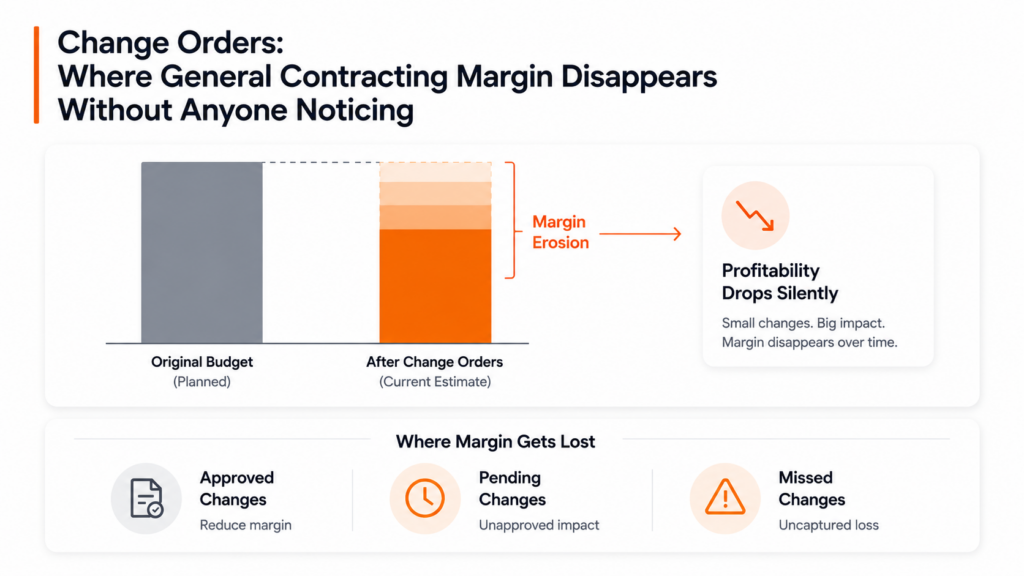
Add it up. Labor ran over. One change order was priced under actual cost. Materials shifted mid-projects. A callback added uncompensated hours after the job was technically closed.
None of these four things, on their own, look like a crisis. That’s exactly why they survive. A $900 gap here, a $1,200 gap there, a material variance that gets absorbed into “cost of doing business.” By the time the final invoice goes out, the job that bids at a healthy margin closed several points thinner, and there’s no single moment anyone can point to and say, “that’s where it went wrong.” It went wrong in five places, a little at a time.
This is the actual argument for job-level tracking on project work. Not that it prevents changing orders, material price shifts, or callbacks. All three are a normal part of commercial electrical work and always will be. The difference is whether you find out about the drift while the job is still open, when you can reprice a pending change order or flag a labor overage to the crew to lead, or three months later, when the only thing left to do is note it for next time.
Where Budget vs Actual Fits Into This
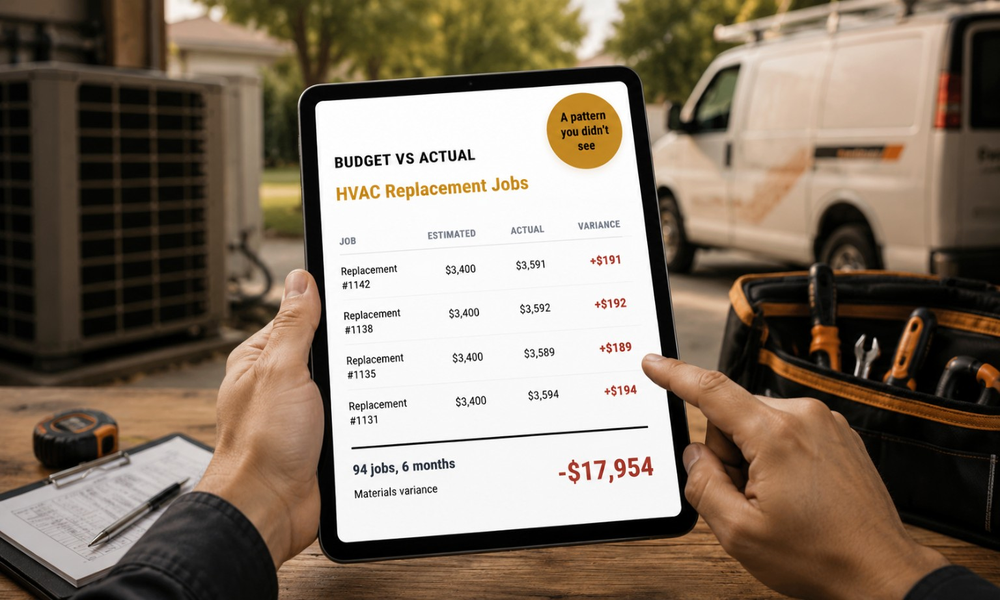
This is what MyWorkbelt’s Budget vs Actual tracking is built for: comparing what a job was estimated to cost against what it’s actually costing, by job type, while the job is still open. On a project like the one above, that means the labor overage on rough-in is visible in week one, not in the final report. The change order gets flagged as underpriced before it’s invoiced, not after. The material variance shows up against the specific job, not buried in a general ledger line.
Every month, that same data feeds into a Growth Review with a named Client Success Manager, so the pattern doesn’t just get surfaced. It gets discussed: is the labor template due for a repricing? Should change orders route through a different pricing check before they go out? Those are decisions an owner can only make with the data in front of them while there’s still time to act on it.
FAQ
Does job cost work for project-based electrical work, not just service calls?
Yes. Budget vs Actual is built to track estimated versus actual cost by job, which applies to multi-week project work the same way it applies to a single service call. The electrical-specific setup covers both project billing and service work, so labor and material variance can be tracked at the job level regardless of how long the job runs.
How does electrical contractor software catch a change order that’s priced wrong?
It compares the change order’s priced value against the labor and material template it was built from and flags it against actual cost as the job progresses. If a change order is quoted off an outdated labor rate, that gap shows up in the job Budget vs Actual report before the job closes, not after the final invoice.
What’s the difference between tracking margin at year-end and tracking it by job?
Year-end tracking tells you what happened. Job-level tracking tells you what is happening. By the time a bookkeeper or accountant delivers a year-end margin number, the jobs that drove it are long closed. Job-level tracking surfaces the same information while the job is still open, which is the only point where an owner can act on it.
Want to see what this looks like against your own job data? Book a demo and we’ll walk through Budget vs Actual using a project scenario from your trade. For electrical-specific pricing and labor benchmarking resources, NECA is a useful outside reference.