Quick Links
- What ERP Was Actually Built to Do
- The Question You’re Actually Asking
- What a Field Service Business Actually Needs
- The Real Cost of the Wrong Fit
Someone told you that you need an ERP system. Maybe it was a consultant. Maybe it was a software rep who cold-called your office. Maybe you read it in a trade forum thread about “scaling operations.”
Here’s the truth: ERP was built for a different kind of business than yours.
What ERP Was Actually Built to Do

ERP systems exist to connect manufacturing lines, warehouses, supply chains, and finance departments across large, multi-location companies. Think of a company running three factories, a distribution network, and a finance team of 40 people who all need the same numbers at the same time.
That’s not a 10-person electrical outfit. That’s not a 15-tech plumbing shop. That’s not you.
ERP platforms are priced, built, and supported for that scale. Implementation alone can run six figures and take months. The reporting is built for a CFO comparing plants, not an owner trying to figure out why last month’s revenue didn’t turn into last month’s paycheck.
The Question You’re Actually Asking
If you’re a service business owner looking at ERP, you’re probably not trying to solve an “enterprise resource planning” problem. You’re trying to answer one of these:
- Which jobs made money and which ones didn’t?
- Why does a great revenue month still leave a thin bank account?
- Is my pricing on a job type still accurate, or has it drifted?
- Can I see this without spending three hours in a spreadsheet on Friday night?
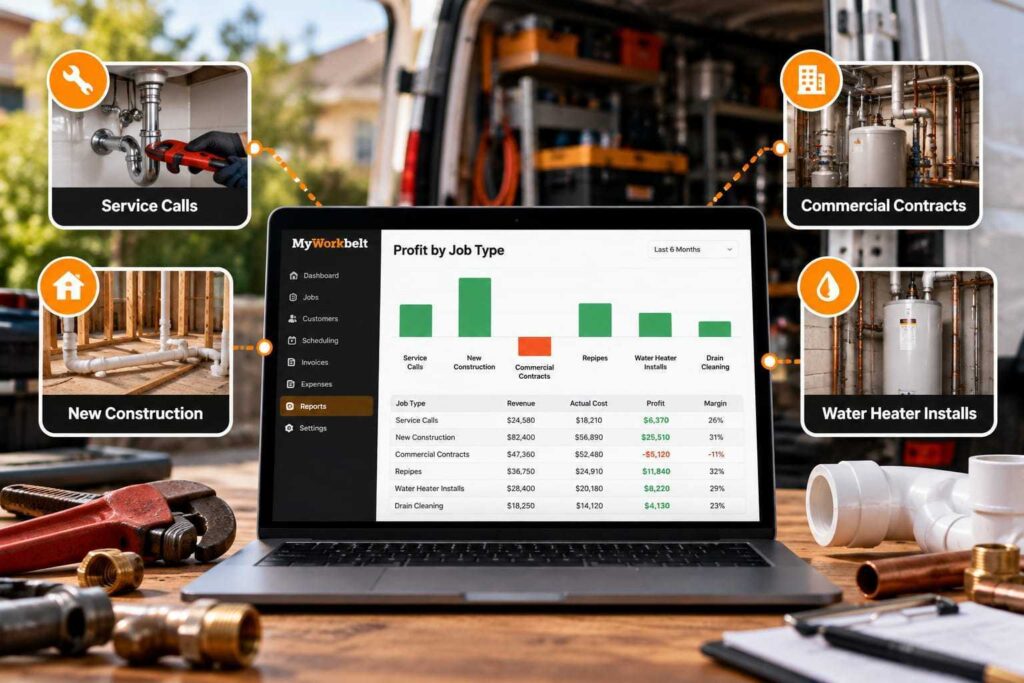
None of those questions need a platform built for coordinating warehouses. They need job-level cost tracking, matched to your actual jobs, in a system sized for your actual team.
Why “Bigger Software” Feels Like the Answer
It’s an easy trap. Your current field service tool tracks who did the job and sent the invoice, but it doesn’t tell you whether the job was worth doing. So the instinct is: I need something bigger. Something that does everything.
But “everything” is the problem. ERP systems are general-purpose by design, which means every module gets configured, customized, and maintained by someone. Most 10-to-25 person trades businesses don’t have an IT department. They have an owner, a few techs, and maybe an office manager who’s already stretched thin.
One documented case: an HVAC operation tracking materials costs against estimates found $17,954 in unsurfaced loss over six months, $191 over budget on every one of 94 replacement jobs. That’s not an ERP-sized problem. That’s a job-costing problem, and it’s exactly the kind of thing that gets buried in a system built for something else entirely.
What a Field Service Business Actually Needs
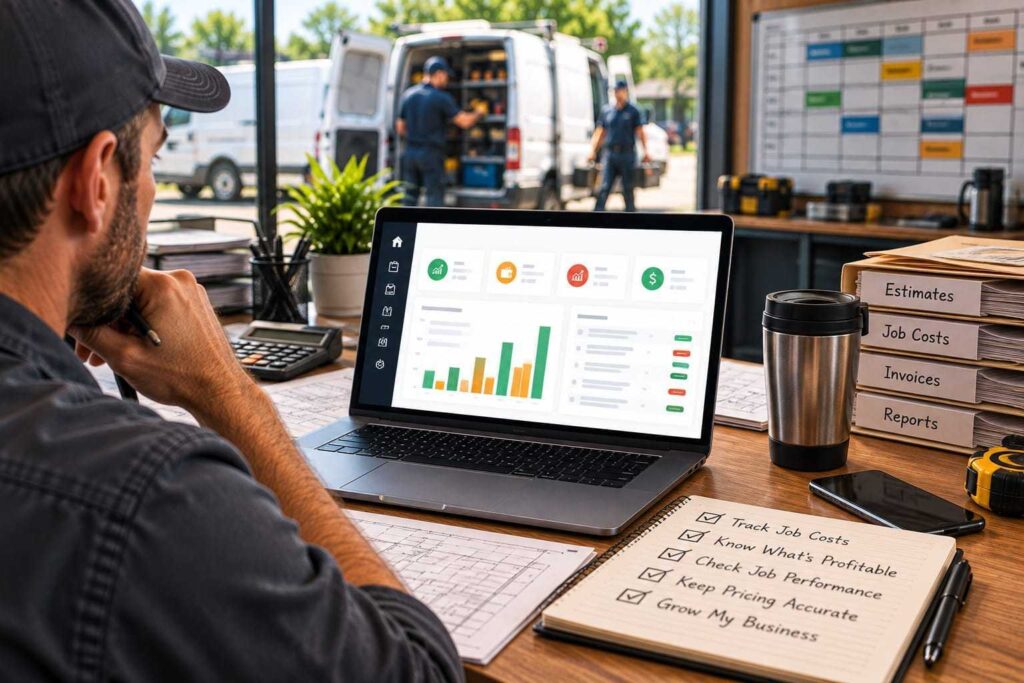
A service business doesn’t need enterprise resource planning. It needs to know, job by job, what got spent versus what got estimated, and it needs someone to walk through those numbers with the owner every month. That’s the whole idea behind MyWorkbelt.
That’s a much smaller, much more specific job than what ERP is built to do. It’s also a job that field service management software built for trades, not manufacturing, can actually do well.
The Real Cost of the Wrong Fit
Choosing ERP when you’re a small service business costs more than implementation. It costs time your business doesn’t have, training your crew doesn’t want to sit through, and a system that answers questions you weren’t asking in the first place.
The businesses that actually need ERP know it. They have multiple locations, a finance team, and inventory flowing through a supply chain. If that’s not your business yet, the fix for “I can’t see if my jobs are profitable” isn’t a bigger system. It’s the right one.
See what job-level profit tracking looks like for a trades business →