Quick Links
- The Tools Told Me What Happened. Not Whether It Was Worth It.
- Two Things Came Out of That Realization
- What I Want You to Take from This
I remember the month clearly. The revenue was up. Invoices were going out faster than they had all year. By every number I usually looked at, it was a good month.
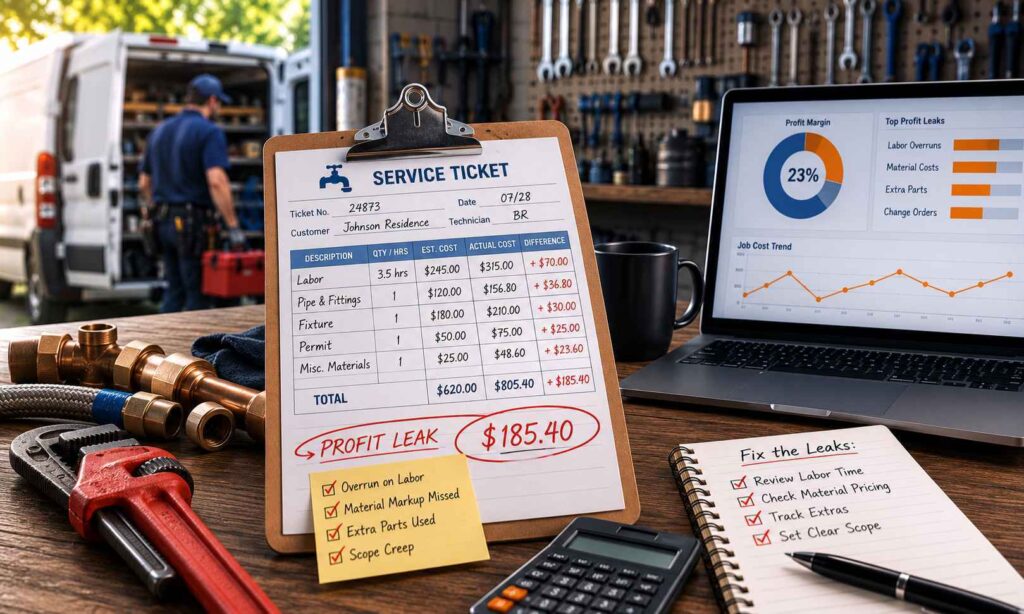
Then my bookkeeper sent over the P&L, and the cash in the bank didn’t match the story the revenue number was telling me. Same crew. Same trucks. Same jobs I’d run a hundred times before. And somehow, we’d worked harder and made less.
I did what most owners do. I blamed the slow-paying customer. I blamed a supplier price hike I’d heard about but hadn’t actually checked. I blamed the weather, if I’m honest. What I didn’t do, at first, was sit down and ask the one question that mattered: which specific jobs made money that month, and which ones didn’t?
Twenty years running a service business, and it took me longer than I’d like to admit, started asking it that directly.
The Tools Told Me What Happened. Not Whether It Was Worth It.
Once I started asking, I went looking for the answer in the places I already had. None of them had it.
My field service software showed me every job that was scheduled, dispatched, and invoiced. It was good at that. But “247 jobs completed, $380,000 invoiced” tells you activity, not profitability. It doesn’t tell you that 40 of those jobs quietly lost money on materials while you were busy feeling productive.
My spreadsheet was worse, honestly, because at least the software was consistent. The spreadsheet only existed because I built it myself on a Friday night, pulling numbers by hand from three different places, hoping I hadn’t fat-fingered a formula.
Read more about the hidden cost of manual job costing in “What Is Job Costing in Field Service Software?“. It took hours. It was always a little stale by the time I finished it. And it told me about the past, never in time to change anything about the present.
Year-end accounting was the least useful of all. My accountant is good at his job. But a report in March about what happened the previous January didn’t help me price the next job correctly in April. By the time the annual numbers confirmed what I suspected, I’d already run the same underpriced job another 40 times.
Here’s what I actually needed, and what none of these gave me: which job types were profitable, by how much, updated close to real time, broken down clearly enough that I could do something about it before the pattern cost me another six months.
Two Things Came Out of That Realization
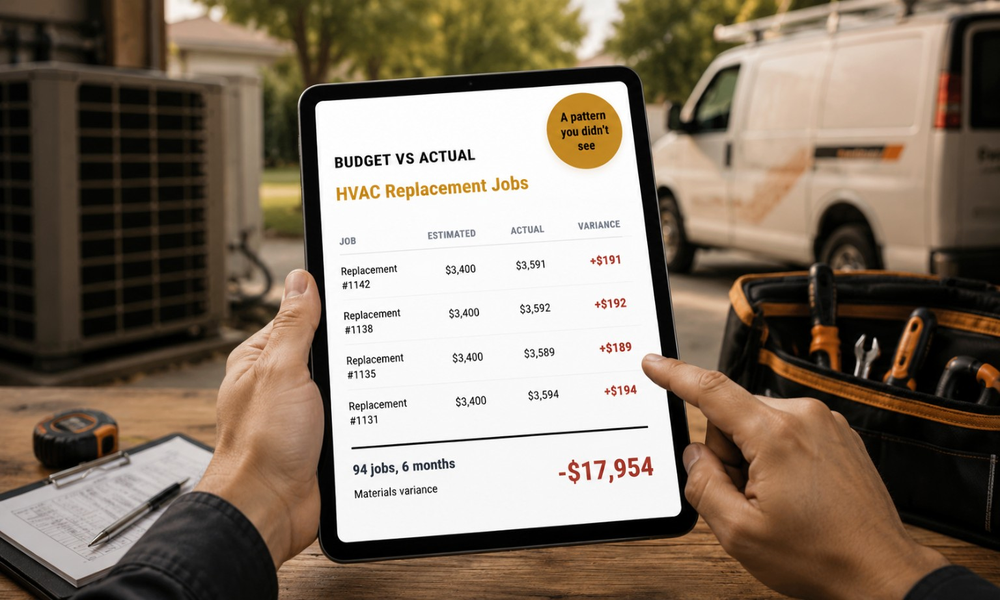
The first is Budget vs Actual. Before a job starts, you know what you estimated it would cost in materials, labor, and time. After it’s done, the software shows you what it actually costs. Not at year-end. Not after your bookkeeper reconciles three platforms. As the jobs happen. If your materials on a job type are running overestimated by $191 for a job, and you’ve run 94 of those jobs this year, that’s $17,954 you didn’t know you were losing until someone showed you the number. See how Budget vs Actual works.
The second thing is less obvious, and it’s the one most software company skips. A dashboard full of accurate numbers doesn’t change anything by itself. I’ve seen plenty of owners, myself included at times, look at a report, nod, and go right back to running the business the same way. Data doesn’t change behavior. The conversation is done.
That’s why every MyWorkbelt account includes a monthly Growth Review with a real person, not a bot summary, not an automated email digest. Someone sits down with your numbers and with you, once a month, and walks through what’s trending, what changed, and what to do about it. I’ve sat in enough of these myself, on both sides of the table, to know the difference between seeing a number and being walked through what it means for next week’s pricing decision.
The software finds a leak. The Growth Review is what makes sure you act on it.
What I Want You to Take from This
If you’re reading this because you had a month like mine, a busy one that somehow didn’t pay like it should have, I want you to walk away with one thing.
The size of your revenue isn’t the number that matters most. A $400,000 shop and a $3 million shop can both be quietly losing money on the same job type for the same reason: nobody’s looking at cost by job, in real time, closely enough to catch it. I’ve talked with owners at both ends of that range who had the exact same blind spot I did.
What matters is knowing, job type by job type, which ones are worth doing again and which ones are quietly costing you money every time you say yes to them. That’s not a productivity question. It’s not about doing more jobs faster. It’s a profit question, and it’s the only one I built on this platform to answer.
If you’re curious about what that looks like against the software you’re using today, see how MyWorkbelt compares to Jobber to see exactly what it costs, with nothing hidden in a second invoice. Plenty of operators who’ve made the switch from other platforms describe the same moment I had: the numbers finally matching what they knew was true about their business.
Twenty years is a long time to ask a question before finally building the thing that answers it. I’d rather you find out this month than in year twenty-one.