
Quick Links
- Why do busy HVAC companies still feel broke?
- The Profit & Loss Doesn’t Show You the Problem Fast Enough
- The HVAC Margin Leak Reveal Most Owners Miss
- Why Most HVAC Software Stops One Layer Too Early
- 3 Places HVAC Companies Lose Margin Without Seeing It
- The Real Cost of Not Knowing
- What Job-Level Visibility Actually Changes
- The Owners Who Usually Catch This Fastest
- How to track HVAC job costs?
- The Point Isn’t About Getting More Reports
- A Final Thought
Most HVAC owners don’t have a scheduling problem. They have a visibility problem. Their HVAC margin leak tracking system is not showing the actual result.
Their calendar is full. Trucks are moving. Revenue looks fine on paper. Then Sunday night shows up, you’re at the kitchen table staring at QuickBooks, and the question lands again: which of these jobs are actually making money?
That’s the question most field service software still can’t answer. Because it tracks activity, not the margin.
Why do busy HVAC companies still feel broke?
A 12-tech HVAC operation can run 40 replacement jobs a month and still bleed margin quietly for a year before anybody catches it. Not because the owner is careless, but because the leak hides inside the work.
Materials drift job upward by job. Labor costs rise. Emergency parts run. One technician takes 20 minutes longer per route. Warranty callbacks stack in the background. Individually, nothing feels alarming. Together, it turns a good revenue year into a cash flow headache. Revenue covers the noise for a long
time. The margin doesn’t.
The Profit & Loss Doesn’t Show You the Problem Fast Enough
Your company’s monthly Profit & Loss statement is useful. It tells you what happened to the business overall. It usually cannot tell you which job category caused the problem. This is what most HVAC business owners don’t realize.
You can lose money on residential replacements for six months while commercial maintenance quietly keeps the company afloat. The total revenue number still looks respectable. The business still feels “busy.” By the time the year-end numbers make it obvious, you’ve already repeated the same mistake across hundreds of jobs.
The HVAC Margin Leak Reveal Most Owners Miss

Let’s Imagine: You’re running a 12-tech HVAC company. Replacements are your bread and butter. The margin looks fine on paper. Then somebody finally compares estimated vs. actual material costs by job type.
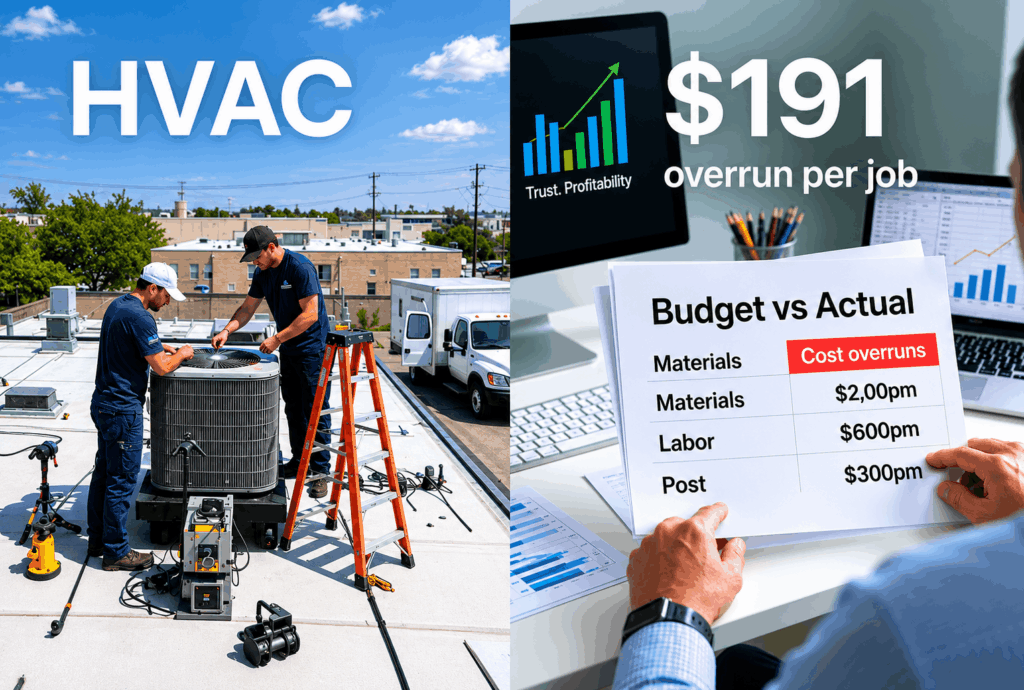
Residential replacement overruns: $191 per job. 94 jobs across six months. $17,954 gone without any red flags. The only reason could be the software that tracked the jobs, but not what they actually cost. The data existed, but not in a form you could use.
That’s what makes HVAC margin leaks dangerous. They don’t arrive like a fire alarm; they will just give you a blank background.
Why Most HVAC Software Stops One Layer Too Early
Most field service software was built around productivity. Scheduling. Dispatch. Invoicing. Route management. These services matter as you really need them. But most owners eventually hit the same wall: the software can tell you where the technician is, but not whether the work was done properly or not or whether the work is complete or not.
That’s the missing layer. Budget vs Actual by job type. What you estimated versus what actually happened. The actual thing happened was the labor, materials, and time on job. That’s where businesses lose margin without knowing it.
3 Places HVAC Companies Lose Margin Without Seeing It
1. Replacement Packages Priced Before Costs Changed
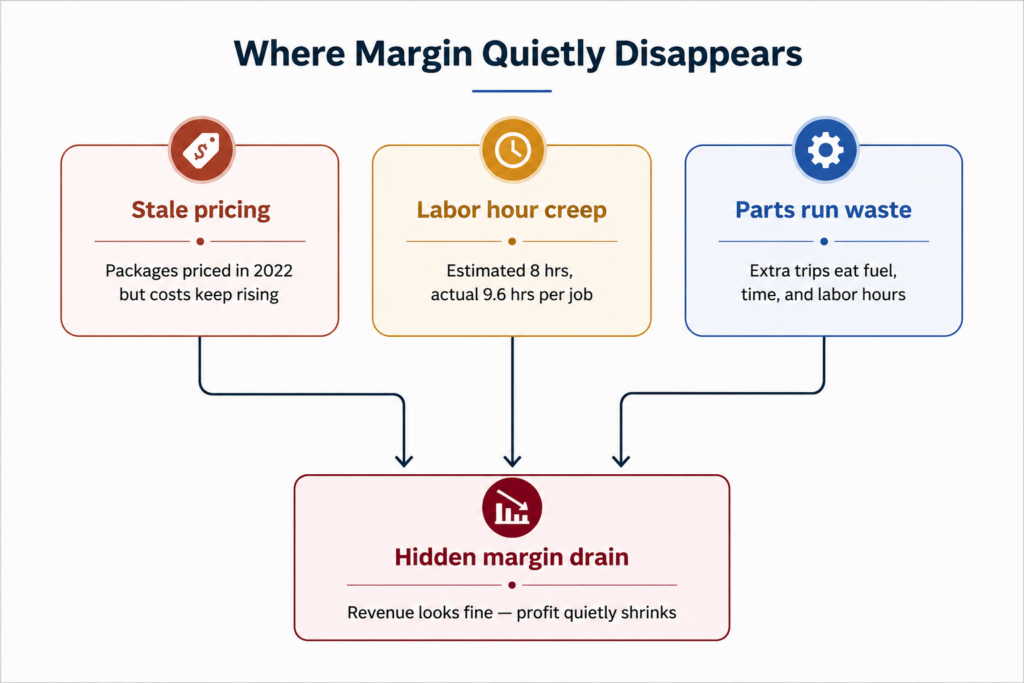
You priced your replacement packages in 2022. Copper prices changed, equipment costs changed, labor costs changed, fuel costs changed, but your pricing is still the same. Means your business is still charging the same prices it was before the cost increases happened.
The HVAC companies are still getting plenty of work because customers still need the service. The calendar looks full, so the business also looks running well from the outside.
But behind the scenes, each job is making less profit than before because your company has increased the costs while the pricing has stayed the same.
2. Labor Hour Creep
When pricing the HVAC install, the owner estimated the crew would need 8 hours to complete the job. In reality, most installs take 9.6 hours instead of 8. That means every job takes about 1.6 extra labor hours.
No single job looks disastrous. Nothing crashes. Customers may still be happy. But when that extra labor time happens across dozens or hundreds of jobs, payroll costs quietly eat away at the profit over time.
The extra labor cost gets mixed into total payroll expenses instead of being tracked per job. So owners see payroll increasing, but they can’t easily identify which specific jobs are causing it.
3. Technician Routing and Parts Runs
You trust your technicians, and you should. But trust and visibility are different things.
If technicians keep making additional trips to pick up parts, the business loses time, fuel, and labor hours. One trip may seem small, but repeated over many jobs, the cost adds up. Poor scheduling or unnecessary driving between jobs wastes technician time and fuel. When technicians must return to fix incomplete or incorrect work, the company spends extra labor and travel time without earning additional revenue.
The issue is not necessarily that employees are bad at their jobs. The business systems, planning, scheduling, or processes may be causing the inefficiencies. The important part is that small problems are easier and more affordable to fix early. If ignored, they slowly grow into major profit drains.
The Real Cost of Not Knowing
The financial hit matters. But the operational hit is worse. When owners can’t see the margin clearly, they start making defensive decisions. They hesitate to hire. They invest more in training. They lower marketing spend at the wrong time and place. They assume the business has a revenue problem when it actually has a visibility problem.
That’s how good HVAC companies get trapped in almost all situations. They are always busy but never satisfied.
What Job-Level Visibility Actually Changes
Once you can see Budget vs Actual by job type, decision-making gets sharper fast.
The replacement package that needs repricing becomes visible before another year passes. The technician route driving overtime drift shows up in the data rather than in a gut feeling. The job category carrying hidden material overruns stops being a mystery and becomes a decision.
Some jobs bring in good money. Others generate revenue and very little margin. The difference between knowing which is which and guessing is the difference between growing cleanly and scaling the leak.
The Owners Who Usually Catch This Fastest
The HVAC companies with 5 to 25 employees usually feel this problem first. The business has grown beyond whiteboards, spreadsheets, and basic software. More technicians. More jobs. More moving parts. But it’s still small enough that the owner feels every margin squeezed personally.
This is usually the stage where owners realize something doesn’t add up. Revenue keeps climbing. The schedule stays full. Yet confidence in the numbers keeps getting weaker.
That’s typically when they start looking deeper at job-level profitability.
How to track HVAC job costs?
Pull your highest-volume HVAC job category from the last 90 days. Then ask:
- What did we estimate for labor? What did it actually cost?
- What did materials actually come in at?
- Which technicians consistently ran long?
- Which jobs triggered callbacks or extra parts runs?
- Did the margin match what we thought it would be?
Most owners have pieces of this data somewhere. Very few have it surfaced cleanly enough to act on monthly. That’s exactly what MyWorkBelt‘s Budget vs Actual tracking does, compares what you planned to spend on each job against what you actually spent, by job type, every month. Not as a year-end exercise. As a regular operational view.
And the monthly Growth Review is where a real person sits with you and goes through what the numbers mean and what to do about it. Because data without that conversation usually becomes a report nobody reads after week three.
The Point Isn’t About Getting More Reports
Nobody wants a new dashboard. Most HVAC owners already have software full of reports that nobody reads after 3 weeks. The point is finding the leak before another year disappears into “we were slammed, but somehow cash still felt tight.”
That requires two things:
Clean job-level data and a real conversation around what the numbers actually mean.
Data without interpretation usually looks like wallpaper.
A Final Thought
More jobs don’t automatically create more profit. Sometimes they scale the leak faster. The HVAC companies that grow cleanly over the next five years won’t just be the busiest operators. They’ll be the ones who can answer one question with confidence:
Which jobs are actually making us money?
That’s what more profit from every job actually looks like, not just less paperwork. See how MyWorkBelt’s job-level profitability tracking works.