Quick Links
- The Big Job That Lost You Money
- What your software is missing
- What HVAC job costing shows you
- It’s never just one job type
- The fix isn’t quoting everything higher
You’ve got a really good job on your schedule this week. Biggest invoice you wrote all month, customer happy, crew home on time. That same job might be the one quietly losing you money, and the invoice will never tell you that. It happens more often than HVAC owners like to admit, and it has nothing to do with how good you are at your job.
Revenue tells you what came in. It doesn’t tell you what it cost you to get it. Those are two different numbers, and most field service business owners only ever look at one of them. Your monthly report combines all jobs into a single line. It can’t tell you that three of those jobs paid for themselves twice while one of them quietly gave the money back.
The big job that lost you money
Picture a residential system replacement. Four-ton unit, quoted clean, signed the same day. The crew’s in and out in a few hours, the invoice goes out, and customers are happy. You mark the week down as a good one and move to the next job on the board.
Here’s what doesn’t show up on that invoice.
The material costs exceed your budget. The unit costs more than the catalog price you quoted against, or a part wasn’t in stock, and the substitute costs more. Maybe the first visit didn’t finish the install, so there’s a second truck roll your crew doesn’t even mention, because it’s just part of doing the work. Maybe the duct modification took an extra hour nobody scoped at the walk through. Two weeks later, the customer calls about a rattle, and now there’s a warranty visit with no invoice attached to it at all.
None of that is unusual. None of it is your crew’s fault. It’s just what an install looks like once it leaves the page. And none of it gets subtracted from the number you call revenue when you look back at the month.
What your software is missing
Your bookkeeper isn’t miscalculating the books; they just don’t have the right software tools to tell you what you need to know. Your accountant works off the P&L, and the P&L only shows totals. It tells you in March what you needed to know in January, and even then, it tells you by month, not by job. The problem is, Your software wasn’t built to separate job cost from revenue, so the loss was hidden inside a number that otherwise looks fine.
What HVAC job costing shows you
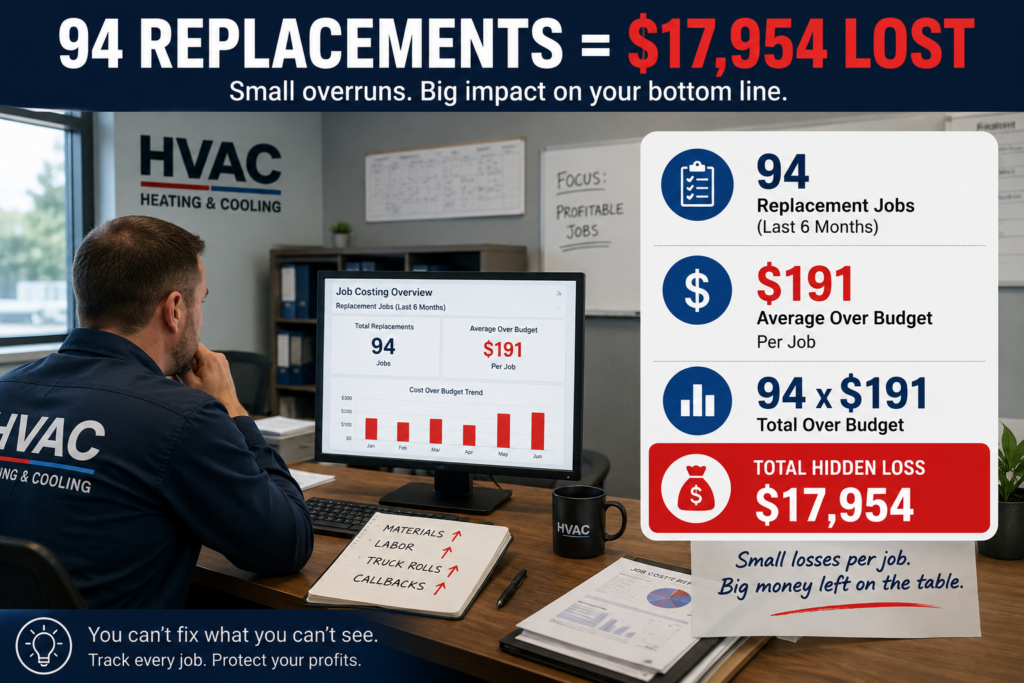
This is the part of most reporting misses, and it’s the whole reason for HVAC job costing matters. Your monthly numbers tell you that the month was good. They don’t show you which job made a profit and which one quietly lost money.
A typical scenario My Workbelt clients uncover you’re a 12-tech HVAC operation. Replacements are your bread and butter. The margin looks fine on paper. But the materials line alone, just materials, runs $191 over budget per job. Across 94 replacements over six months, that’s $17,954 you didn’t know you’d lost. And that number doesn’t even count the second truck roll, the extra labor hour, or the warranty callback. Those come on top of it.
It’s never just one job type
And that’s one job type. Replacements. What about your service calls? Your maintenance agreements? Do your panel upgrades? If a job as straightforward as a replacement can hide this much, you must ask the same question about everything else on your board.
Take your service tickets. A typical scenario My Workbelt clients uncover you priced your service tickets back in 2022 and haven’t touched the number since. Materials and labor have moved 18% at that time. The price hasn’t. Nobody decided to lose money in that job category. It just sat there while everything around it got more expensive.
Multiply that across a 12-tech shop running four or five job types, and you’re not looking at one leak. You’re looking at several, each one small enough to miss on its own. The job you’d call your best week might not be your best job. It might just be your loudest one.
The fix isn’t quoting everything higher
It’s tempting to just slap an extra ten percent onto every quote and call it a day. Don’t. That makes your already-profitable jobs more expensive too, while doing nothing to fix the one job type that’s losing you money. It also hands those well-priced jobs straight to whoever’s still quoting the old way.
The fix is actually much simpler than that. See your margin by job type, every month, not just your revenue by month. Then raise the price on the job type that actually needs it and leave the rest alone. That’s what Budget vs Actual is built to show you, broken out by job type so a replacement and a service ticket never get averaged into one number again.
And you don’t stop at the report. Once a month, you sit down with the same person, your Growth Review, and go through what changed since last time. No rotating account managers. No support tickets. Just a designated CSM who already knows your job types and knows what a Friday afternoon part run actually costs you. You don’t start over with a stranger every few months.
Hello Folks, I am Sree. I spent 20 years running a service business and got hit by this exact issue. I started looking at margins by job type instead of revenue per month. That’s the whole reason I built My Workbelt Field Service Management Software.
If you want to see how this works with your actual numbers, not a hypothetical example, book a 30-minute demo. Bring your highest-volume job type, and we’ll map out a real scenario for your business. There’s zero pressure afterward, either. Most owners we talk to take a week to think it over, and we prefer it that way.