Quick Links
- Leak 1: Materials Overruns Electrical Contractors Absorb on Every Quoted Project
- Leak 2: Project Scope Creep, Electrical Contractors Never Get Paid For
- Leak 3: Labor Hour Creep on Panel Upgrades and Quoted Projects
- Leak 4: Electrical Service Call Pricing That Has Not Moved Since 2022
- Leak 5: Electrical Contractor Quotes That Age Out While You Run Calls
- Leak 6: Electrical Contractor Truck Inventory That Leaves Without a Work Order
- Why These 6 Leaks Stay Hidden in Electrical Businesses Specifically
You ran a full schedule this month. Service calls, panel upgrades, and a couple of commercial jobs. The invoices went out on time.
So why does the number in your account not match the month you just had?
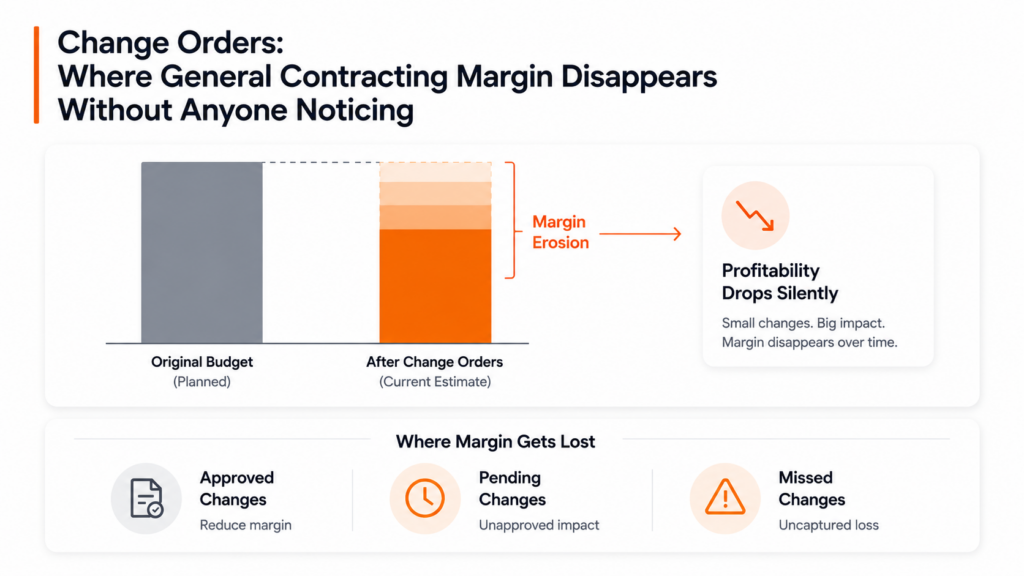
Electrical contractors are not losing money because they are bad at the trade. They are losing it in the 6 places that never show up on a P&L: the gap between what a job should have cost and what it actually cost, the quotes that went cold while you were pulling wire, the jobs priced on 2021 labor rates that you are still running in 2026.
This is where the money goes. And it is going there every month, whether you can see it or not.
Leak 1: Materials Overruns Electrical Contractors Absorb on Every Quoted Project
Electrical work has a materials problem that most other trades do not face at the same scale: copper.
Wire prices move. They have moved significantly over the past three years. A project you quoted, using $3.80-per-pound copper wire pricing, ships at $4.60. A commercial tenant build-out with 2,400 feet of 12/2 Romex is quoted at one number but installs at another. The difference does not come out of the customer’s pocket. It comes out of yours.
But copper is only a visible version of this problem. The deeper version is the accumulation of smaller overruns across every project: a box of wire nuts here, a handful of breakers there, a conduit run that needed more fittings than the estimate assumed. Individually, none of them register. Across 60 completed jobs in a quarter, there is $14,000 in untracked materials variance that appears nowhere on your books except as a profit squeeze in your gross margin.
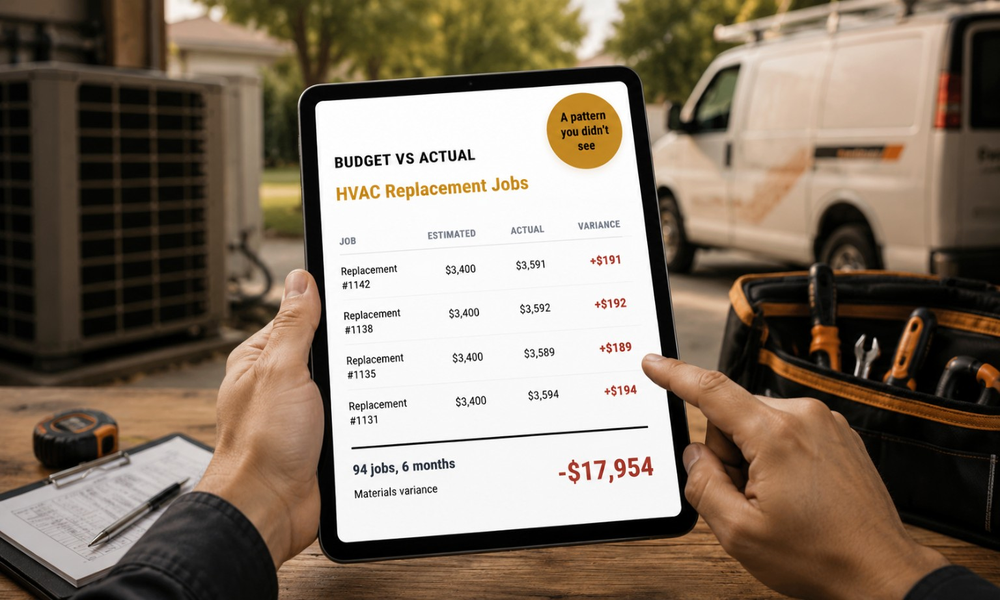
A 14-tech electrical operation that runs commercial and residential work found an average materials overrun of $191 per quoted project after it started tracking Budget vs. Actual by job type. On 78 projects in six months, that was $14,898, and it had been absorbed without a single line in a report pointing to it.
Fixing the problem: The fix is comparing your materials estimate to actual spend after every job closes, at the job level. When the overrun pattern appears, you can see whether it is a specific job type, a specific supplier, or a materials cost that has drifted past your estimating assumptions. You fix it once. It stays fixed.
Leak 2: Project Scope Creep Electrical Contractors Never Get Paid For

Electrical projects expand. That is the nature of the work. You open a wall to run a new circuit and find knob-and-tube that has to come out. Then start a panel upgrade and discover the grounding is insufficient. You begin a commercial fit-out, and the architect’s drawings do not match what is in the ceiling.
Every one of those discoveries is legitimate additional work. Most of it does not get billed.
Not because contractors are careless. Because the moment the tech is on the job and the customer is standing there asking questions, the path of least resistance is to absorb it and move on. Stopping work, writing a change order, getting it signed, and logging it into the job record feels like overhead when you have three more jobs behind this one and your apprentice is waiting on direction.
So the extra two hours go unbilled. The additional materials get pulled from the truck and disappear into the job cost. The customer pays the original quote. You deliver a job worth 30% more than what you invoiced.
An electrical contractor doing service upgrades primarily tracked this for 90 days. The average unbilled scope expansion across projects requiring field changes was $340 per job. Across 41 such jobs in the quarter, that was $13,940 in completed work that left the building with the customer and never generated revenue.
Fixing the problem: Work orders with a job completion step that requires the tech to log actual time and materials before the job closes. When Budget vs. Actual runs above estimate on a specific job category, the Growth Review surfaces it, and the
conversation shifts from “we should probably do something about change orders” to “here is the specific dollar amount we left on the table last quarter.”
Leak 3: Labor Hour Creep on Panel Upgrades and Quoted Projects
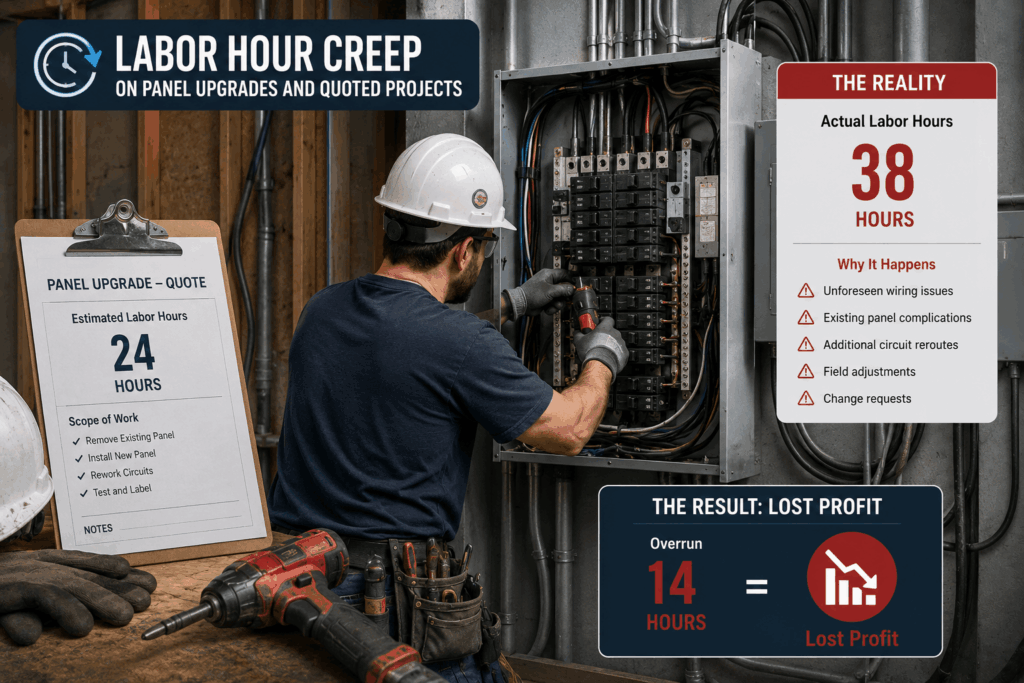
You quote a panel upgrade at 12 hours. Your lead electrician runs it in 14.5.
On one job, the math is $75 to $120 in unrecovered labor, depending on your billing rate. On 35 panel upgrades in a quarter, it is $2,625 to $4,200, quietly missing from your margin.
The creep is not always a performance problem. Sometimes the scope was right, and the estimate was tight. Sometimes the job conditions were genuinely harder: an older home, a cramped panel location, a customer who had questions throughout. But sometimes the estimate was built on an optimistic number from 3 years ago, when your lead was faster, and your apprentice was more experienced, and you have never updated it.
The pattern that emerges when you track this is usually one of three things: a specific job type where your labor estimate is consistently low, a specific technician whose time-on-job runs long across multiple job categories, or a subset of jobs where field conditions predictably add time that the original scope did not account for.
You cannot have any of those conversations until you can see the pattern. And you cannot see the pattern if your only record is a completed invoice and a closed job.
Fixing the problem: The fix is time tracking tied to specific jobs and job types, compared to estimated hours at quote. When 35 panel upgrades average 14.5 hours against a 12-hour estimate, that is a data point, not a bad week.
Leak 4: Electrical Service Call Pricing That Has Not Moved Since 2022

Your service call rate, trip charges, and first-hour rate are a minimum. When did you last change them?
Electrician labor rates have moved significantly since 2021. Journeyman wages in most markets are up 18% to 24%. Fuel is higher than it was three years ago. Your liability insurance was renewed at a rate you did not love. Your vehicle costs went up when you replaced the van.
The customers who have been with you for years did not get a letter explaining any of this. They are still paying the rate you quoted them when you first earned their business.
This leak is invisible because it does not show up as a loss. It shows up as a flat margin on growing revenue; you are busier than ever, doing more jobs, and somehow not meaningfully more profitable. The business is running faster to stay in the same place.
The math on this is not complicated. If your labor costs have increased 20% over three years and your service call rate has not moved, every service call you run is delivering 20% less margin than it did when you set the price. On a business doing 400 service calls a year at a two-hour average with a $95 first-hour rate, a 20% labor cost increase that was not passed through represents roughly $15,200 in absorbed cost per year. Every year.
Fixing the problem: Budget vs. Actual by job type, showing you whether your service call margin is holding, compressing, or collapsing. Not as a P&L percentage but as a dollar figure per job, trended over time. The Growth Review is where that number becomes a pricing conversation with specific evidence behind it, rather than a gut feeling that “we should probably raise rates.”
Leak 5: Electrical Contractor Quotes That Age Out While You Run Calls
You sent a quote for a 200-amp service upgrade, three new circuits, and an EV charger installation. Good job. Good customer. They did not say no. They said they would think about it.
Two weeks pass. You are running a service call, a commercial punch-out, and an emergency that burned your Friday afternoon. The quote sits in your sent folder. You do not follow up. They hire the guy who called them back on day three.
The electrical contracting market has enough demand that most shops are not starving for work. Which means the follow-up problem feels low stakes; there is always another call coming in. The issue is which calls are coming in.
The jobs that come back to you unprompted are usually the smaller ones, the simpler ones, or the customers who already got three bids, and yours was the last stop. The larger project jobs, the panel upgrades, the commercial service work, and the whole-home rewires go to whoever follows up with the most professionalism and the fastest response. Sitting on a quote for 14 days while you handle day-to-day work is not laziness. It is a system problem.
An electrical shop audited its open quotes over 90 days and found $83,000 in quotes more than 10 days old with no documented follow-up. Not all of those were recoverable. But when a CSM made contact with 22 of those customers in a single week, 6 jobs closed, representing $41,200 in revenue that had been sitting in an email thread going nowhere.
Fixing the problem: Estimates and follow-up tracking that puts every open quote on a list with its age, its value, and whether anyone has touched it since it was sent. The follow-up does not require remembering. It appears on a screen every morning.
Leak 6: Electrical Contractor Truck Inventory That Leaves Without a Work Order
Your electricians’ trucks are stocked with the materials and parts they need to handle most service calls without a supply house run. That stock costs money. It also moves without always being logged.
A common pattern in electrical service businesses: a tech handles a small service call, a circuit breaker swap, a GFCI replacement, a light fixture, and pulls parts from the truck. The job gets invoiced. The parts on the truck get replenished when they run low. But the specific parts used on that specific job are not always matched to that job record, which means your materials cost for the job is either estimated or zero.
When it is estimated, it is often low. When it is zero, your gross margin on that job is overstated, and your inventory count is quietly wrong.
Across a service business running 300+ service calls a year, the gap between estimated parts usage and actual parts usage is rarely catastrophic on any single job. Accumulated across all of them, it is typically 3% to 7% of materials spent with no corresponding revenue. On a shop spending $180,000 a year on parts and materials, that is $5,400 to $12,600 in inventory variance per year, which shows up as margin compression with no obvious source.
Fixing the problem: Inventory management connected to job records. When a tech logs the parts used on a completed job, the inventory count stays accurate, and the materials cost for that job reflects what was actually used. The variance between what your trucks carry and what gets logged against jobs becomes visible, and once it is visible, it is manageable.